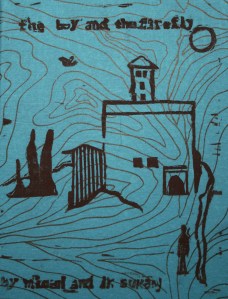
We recorded a show with KUAR Arts and Letters about The Boy and the Firefly It’s called “A Fractured Fairytale.” The following is a transcription of the interview.
KUAR Arts and Letters
A Fractured Fairytale
August 2017

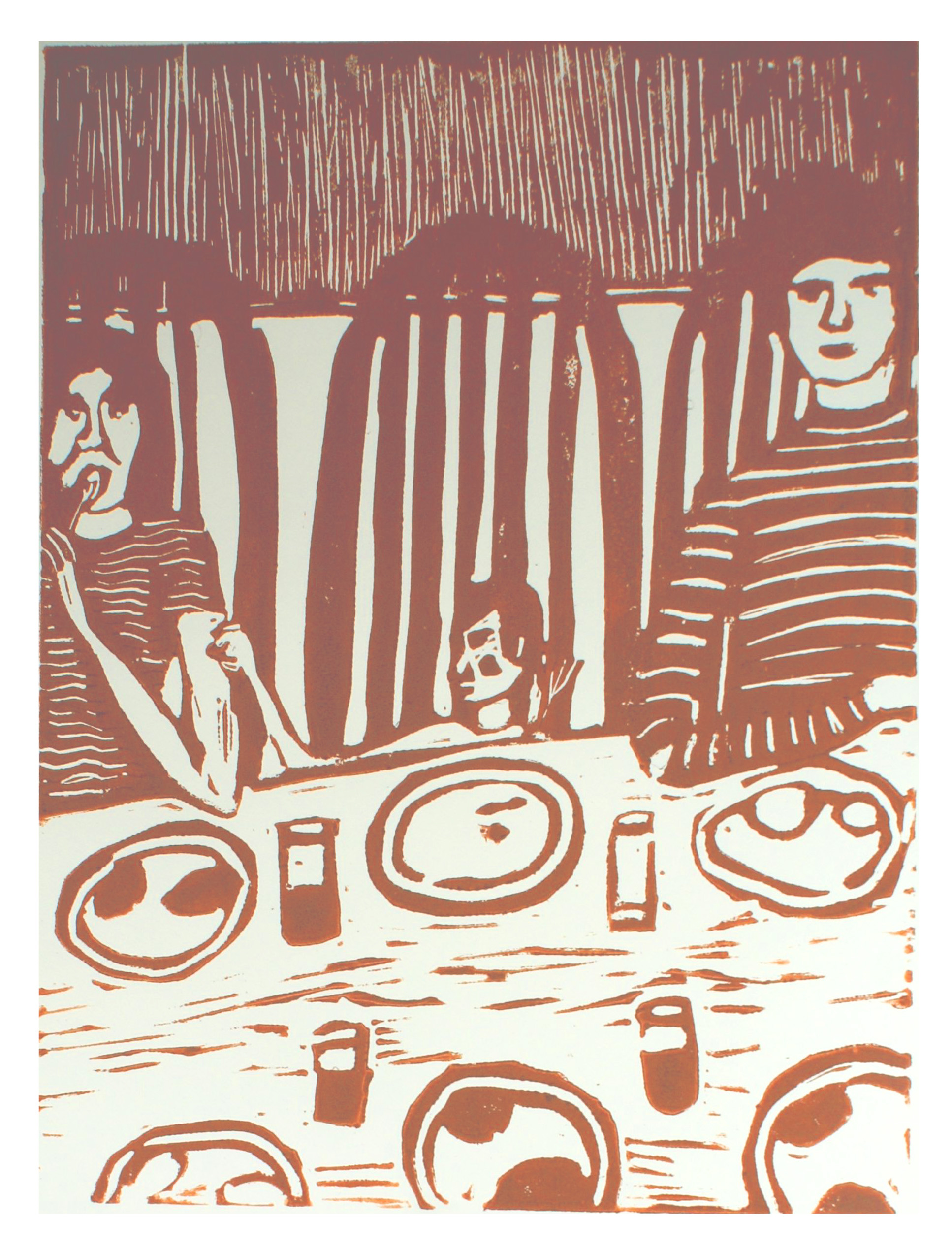
Narrator: Once there was a boy named Calipso. He was small even for a little boy. His family told him so. Calipso never liked hearing that he was small, but he was good-natured about it. And polite to his seven brothers and sisters, except at dinner when they would steal his carrots and he would pout.
J. Bradley Minnick: Today on Arts and Letters, we’ll be talking with musicians and writers Lauren and Micah Sukany. Their children’s story, “The Boy and the Firefly” is a multimedia bedtime story featuring original music and illustrations. Lauren and Micah Sukany, the Damsels in Distress, and the fractured fairytale of “The Boy and the Firefly” on Arts and Letters. This podcast will also be available with an accompanied slideshow. From the studios of KUAR in Little Rock, I’m J. Bradley Minnick and welcome to Arts and Letters, a program providing opportunities for the celebration of the arts and humanities.
Narrator: One evening after a bad day of school and all of his delicious carrots had been stolen, Calipso could take no more. He whistled, then he shouted, then slammed his fists on the table, and then pinched his sister. It seemed as if to the family a noisy ghost had come to dinner. They looked underneath the kitchen table, then behind the door, and then in the cupboards and the pantry. Who had made all that fuss?

Song: The Flight of the Firefly
Wish so long for great to happen.
Now it’s here, I’m here with you.
Show me worlds and so much more.
Things are changing, that’s for sure.
Narrator: “It was I,” said Calipso standing on the table. “Oh!” said his mother and father. Calipso was sent to bed without any dessert.
J. Bradley Minnick: Today we’ll be talking with Lauren and Micah Sukany, husband and wife, creators of the band The Damsels in Distress. Their multimedia children’s book “The Boy and the Firefly” is a fractured fairytale, a postmodern bedtime story for our modern times, complete with original music and illustrations.
Narrator: Calipso trudged up the long, long flight of stairs to his bedroom. However, Calipso’s bedroom was not a room at all. It was more of a windowsill partitioned off from the garret stairwell by pale curtains. Settling into his wicker basket, Calipso peered out a small window at the moon, “Oh, that I was a beam of light too.” Then Calipso noticed a lovely thing. Off in the distance he recognized a faint glimmering light. Slowly that tiny, white bulb floated up to his window like the reverse flight of a lazy paper airplane. Amazed, Calipso watched as the light drifted through a crack in the window and landed on his nose. “Oh!” “Hello,” said the firefly, “Are you ready?” “Ready for what?” “Your flight of course.” Without answering, Calipso took hold of the firefly and they flew off into the night sky glowing ever so dimly.

J. Bradley Minnick: Lauren and Micah Sukany, musicians, artists, writers, welcome.
Lauren: Oh, it’s so good to be here.
Micah: Hello Sir. Thanks for having us.
J. Bradley Minnick: This is a beautiful concept. Where did you guys get the idea?
Micah: At the time I had written several prose poems and a number of parables. I shared a few drafts with Lauren.
Lauren: I was also inspired. Though I had been reading a lot of fairy tales at the time and had just finished one called “The Dragon and the Rose.” It’s by David Scott Daniell and Sheila Stratton. And, it’s where a somewhat frustrated apprentice adventures alongside a princess. So, I told Micah I wanted us to write a fairytale story together with accompanying illustration.
Micah: And we were already writing and performing music as The Damsels, so the idea of putting together a soundtrack came together pretty naturally for us.
Lauren: And then we were offered a show at a gallery called Good Girl Art Gallery. It was really fresh, kind of inventive, innovative place, so we wanted to come up with something that was just really different.
J. Bradley Minnick: So this brought all of your talents together – art, music, and storytelling.
Lauren: And it was something we could do together.
Micah: Yeah, we wanted a complete work of art.
J. Bradley Minnick: And it’s kind of fractured. There are series of stories and they’re all related to the main story, but they’re not all connected directly.
Micah: Yes, um, that was part of from the prose poems. In which I found that if you stack a bunch of images, like collage them, they start forming associations of their own. And it can be very evocative without you actually having to say anything. And then going back to the concept of a dream – dream episodes are connected by the subconscious, if you believe in that kind of thing, and so each of the stories are somehow related. They are related to whatever the subconscious is trying to work out, but the actual content is not at all connected.
J. Bradley Minnick: So, it’s a dream. It’s literally putting us into the mindset of a dream.
Micah: Yeah, it’s about dreams in the style of a dream.
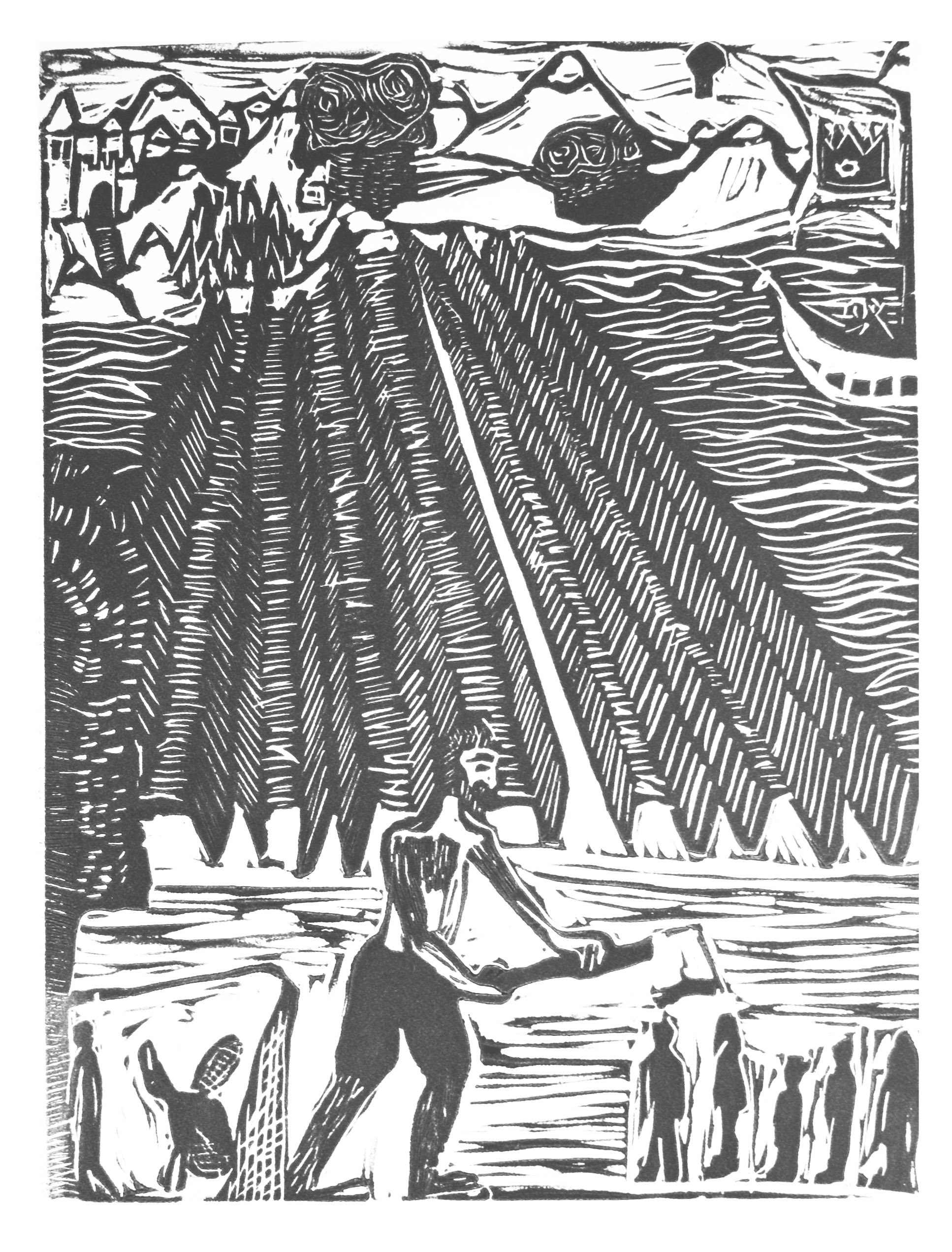
Narrator: Together they flew over wide rivers of clouds and around dense mountains of light into the Land of Dreams. Despite the great distance they traveled, Calipso felt as if he had been there many times before. Everyone has for everyone dreams. Stepping down under the shadow of a tall tree, Calipso felt a bit. “I felt a bit, well, cotton-headed, but all better for being back on the ground.” Looking around he saw seven bridges stretching from one bank of a river to another. “Those are the seven bridges into the Land of Dreams. Before your grandfather’s grandfather’s time there was one bridge, but now there are seven.” Seven. Then all around him, Calipso saw a great multitude of people. He giggled, for they were all in their pajamas. “Those are the dreamers. They wait for Grog.” “Who is Grog?”
Song: Giant Song (Grog)
I am Grog from the land of Nod.
The land of mist and the land of fog.
I am the seven bridges keeper.
I am the way and you are the sleeper.
Seven bridges, seven secret words.
Heads, shoulders, knees, and toes.
Arms and legs and torsos.
Seven bridge, seven secrets heard.
Each body part knows one secret word.
J. Bradley Minnick: So, looking at this book Lauren, it’s beautifully hand done.
Lauren: Thank you.
J. Bradley Minnick: Could you talk a little bit about creating the handmade book.
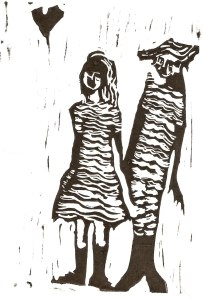
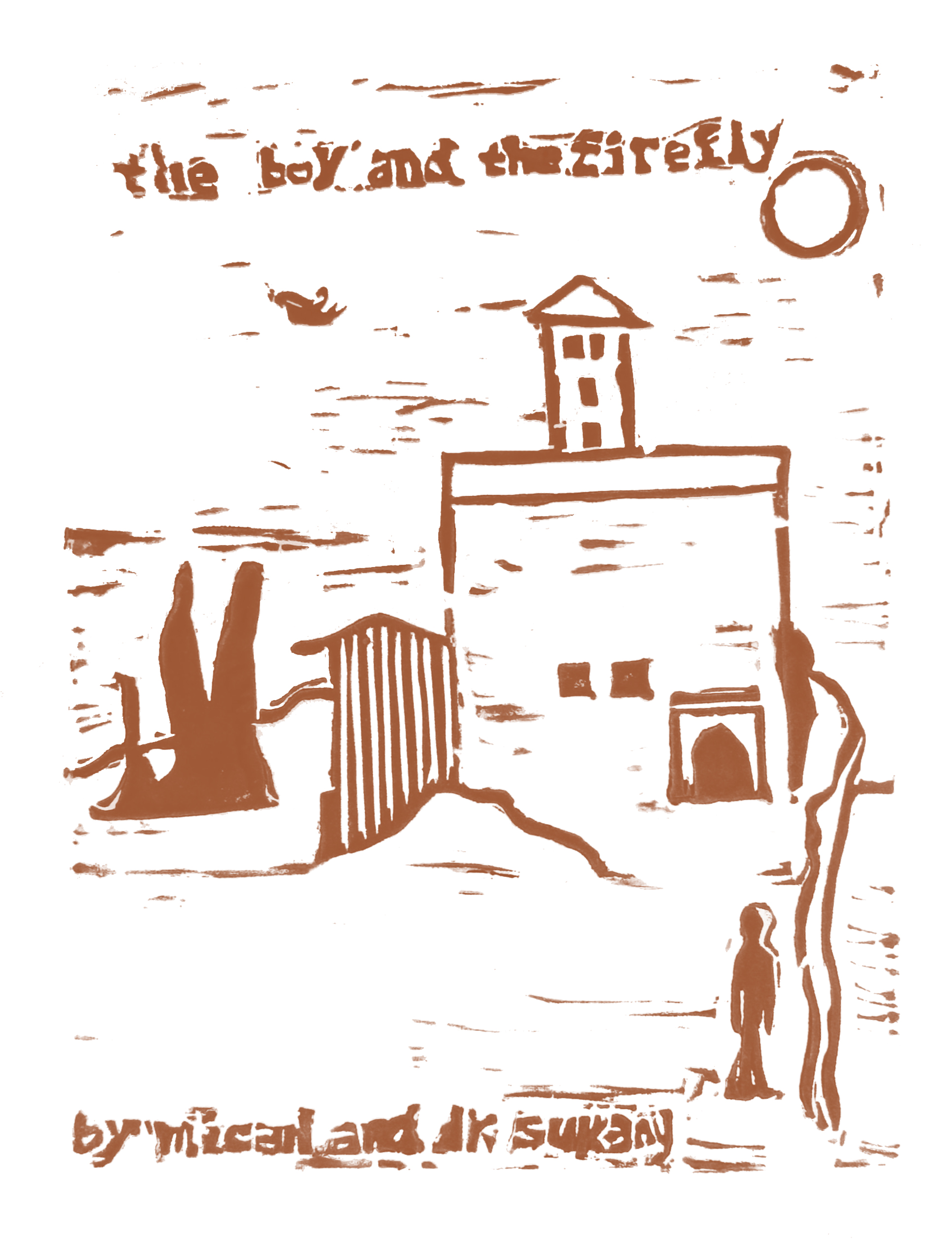
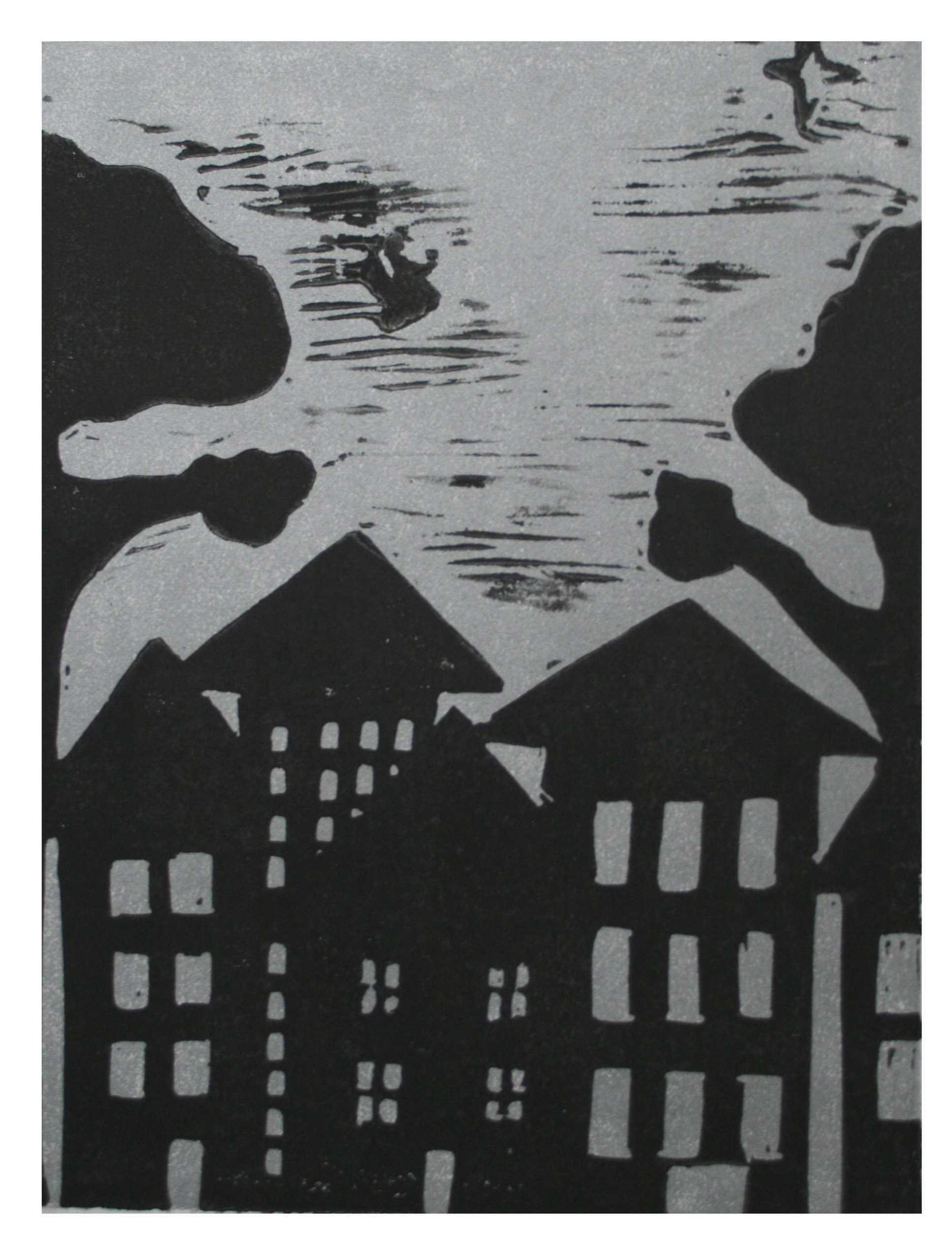
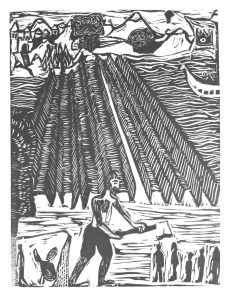
Lauren: Basically, they are linoleum block prints. And some of them are multi-colored. That means that, well, I used a wooden spoon transfer cause I didn’t have access to a press. So, each one of the blocks were inked up, and then a piece of paper was put over it, and then I rubbed a wooden spoon across the back of it. And that’s how the prints’ made. so, if it’s multi-colored, that means I did that twice. And there are I think 13 or 14 illustrations, so as you can imagine, there was just ink and paper all over our little studio apartment at the time. And then I also wanted to hand bind the books, so it was a lot of work, but I feel like that’s kind of what we like. We like a challenge.
Narrator: Calipso was curious, but his curiosity turned to fear when he saw a towering giant. The boy watched as Grog lifted one of the sleepers, placed him on a large, white stone, and dismembered him!

Song: Giant Song (Grog)
Axes, knives, hammers, and cleavers.
I am the giant and you are the sleepers.
Chop, chop, on the chopping block.
Timers, roosters, set alarm clocks.
By the time you wake up, I’ll put you back together.
But there’s no need to worry cause the dream land last forever.
I am Grog from the land of Nod.
The land of mist and the land of fog.
I am the seven bridges keeper.
I am the way and you are the sleepers.
Narrator: “Oh, how horrible!” As Grog reached for another sleeper, Calipso, turning away, noticed a twitch in the arm of the dismembered man and another twitch in the man’s leg. And then an eye blinked. And then a head rolled upright. And then a toe twitched. Slowly each part began to stir and make it’s way across one of the bridges. “How peculiar, I wonder what a toe dreams?” “A toe dreams what an eye dreams, what an arm dreams. Grog the giant puts them all back together.” “How can I get across the bridge?” “Oh, you are quite safe. You are too small for anyone to notice.” Relieved, Calipso crossed unnoticed into the Land of Dreams.
J. Bradley Minnick: So, this story’s taken a turn. Here, we have a, dismemberment, and then a toe dreaming.
Micah: All of the Grimm’s fairytales are fairly violent. And fairytales in general, or at least the older ones, contain a lot of violence. But I think more than anything, it was just a joke to explain how you feel so disconnected when you first wake up. It’s like, “Are these my legs? Are these my eyes?” It’s because you’ve been cut apart and then you’ve come back together. And there’s also kind of an allusion, I think the Egyptians would bury their dead with each of the organs in its own jar, kind of giving it honor. It has a kind of soul.
J. Bradley Minnick: And we talked a little bit about how they’re told in sections. How do you see the sections working together? They are dreamlike, but at the same time they forward the story.
Lauren: I feel like it’s kind of just the idea of just wanting adventure. So, in Calipso’s story, he’s having an adventure and then he’s happening in to other adventurers’ dreams and seeing how their adventure plays out. So, it is dreams, and it is connected through adventure.
J. Bradley Minnick: You’re listening to “The Boy and the Firefly,” a multimedia children’s story written and performed by Lauren and Micah Sukany. Let’s listen to the Land of Dreams.

Narrator: There once was a boy who wanted a bicycle. “Not just any bicycle.” He needed one that would take him on adventures to faraway places. He needed a bicycle that would take him through the sky and to the nearest star where the great princesses lived. He imagined a great and brave quest. He would lay under the almond tree dreaming of these things.
One day an old woman hobbled past. The boy heard her approach, so he opened his eyes and looked at her. “I saw your dreams and I know them.” The boy looked away ashamed of his vulnerability. But, inside her cloak was a red bicycle. The boy’s shame was turned to delight, but at what price? “No money, but if you take the bicycle, your life now will not be your own.” The boy took the red bicycle and peddled and peddled. Some days were tiring and other days weak, but most days were filled with joy–the joy of fulfillment and familiarity.
J. Bradley Minnick: So, we have bicycles and shady deals. The familiar made strange.
Micah: Like a dream, adventure is desired and adventure is achieved.
Lauren: And there can’t be a fairytale without a little old lady hobbling along a road.
J. Bradley Minnick: Or a bicycle maybe. I like the red bicycle. Any reason for red bicycle.
Lauren: I had bought Micah a red bicycle for his birthday. And, that was before I realized that he didn’t actually ride bicycles.
Micah: So, I crashed pretty quickly.
Lauren: Yeah, but there’s something nice about a shiny, red bicycle. You think radioflyer and all that.
Micah: Also, I think adding random details makes it seem as though there were some sort of significance to them. And, it’s just random.
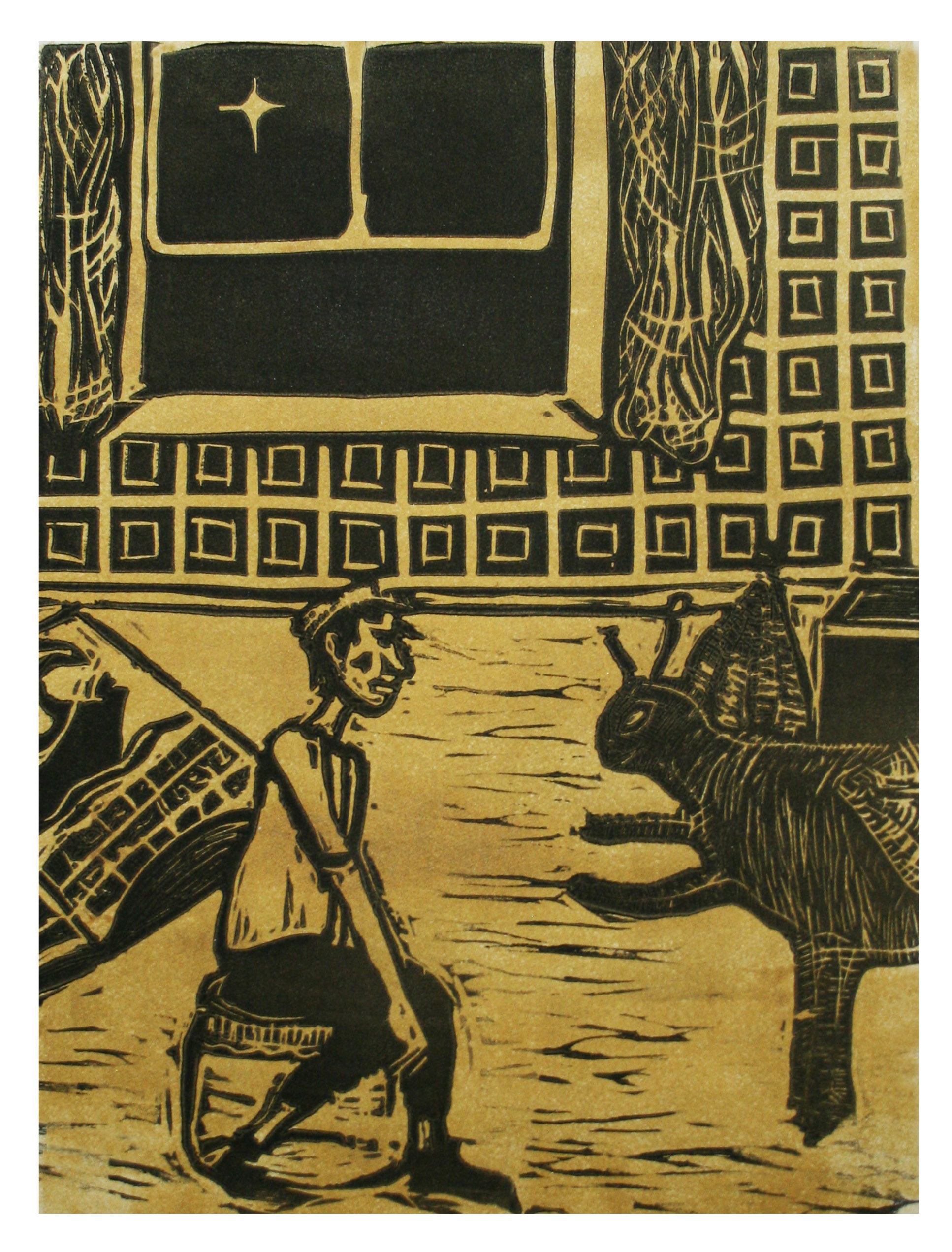
J. Bradley Minnick: So, tell us about this second picture. Would you describe it for us?
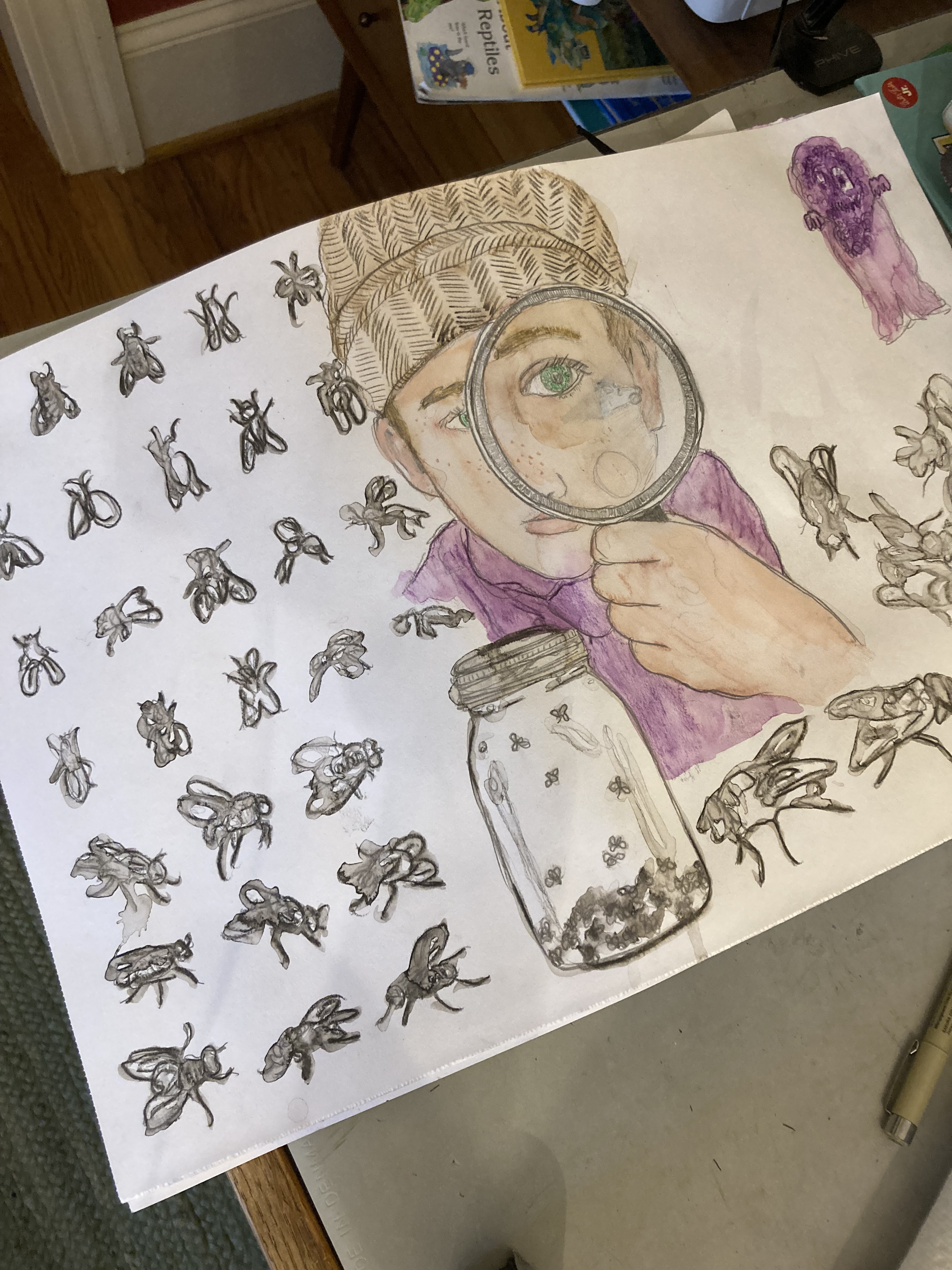
Lauren: Yeah, it’s Calipso, the boy, sitting on a little jar, his little stool. And the firefly comes and starts explaining to him what they’re going to go be doing. And, so it’s this little bedroom with the little window and the bright shining star. And he’s listening to what the firefly has to say.
J. Bradley Minnick: It has kind of an Aladdin feel.
Lauren: I wanted to do that kind of golden color because of the firefly. But, I wasn’t sure. I ended up resolving it by doing the whole image that color versus just the firefly.
J. Bradley Minnick: And Calipso is so small and the firefly is his size.
Lauren: But, I guess then he even shrinks at some point in the story.
Micah: Yeah, that’s one of the things I love about Calipso’s size. It varies wildly depending on what we need him to be scaled at.
J. Bradley Minnick: J. Bradley Minnick, you are listening to a postmodern fairytale, “The Boy and the Firefly” on Arts and Letters
Song: The Boy with the Broom
So my mom gave me a broom
She told me to go sweep my room.
But I sweep all day, I sweep all night.
I sweep the mountains, beach, and sky.
I love to sweep. It’s the thing to do.
I would sweep for them, and I’ll sweep for you.
Cause I sweep all day, I sweep all night.
I sweep the walls both low and high.
I sweep a lot.
J. Bradley Minnick: This is “A Boy with the Broom”

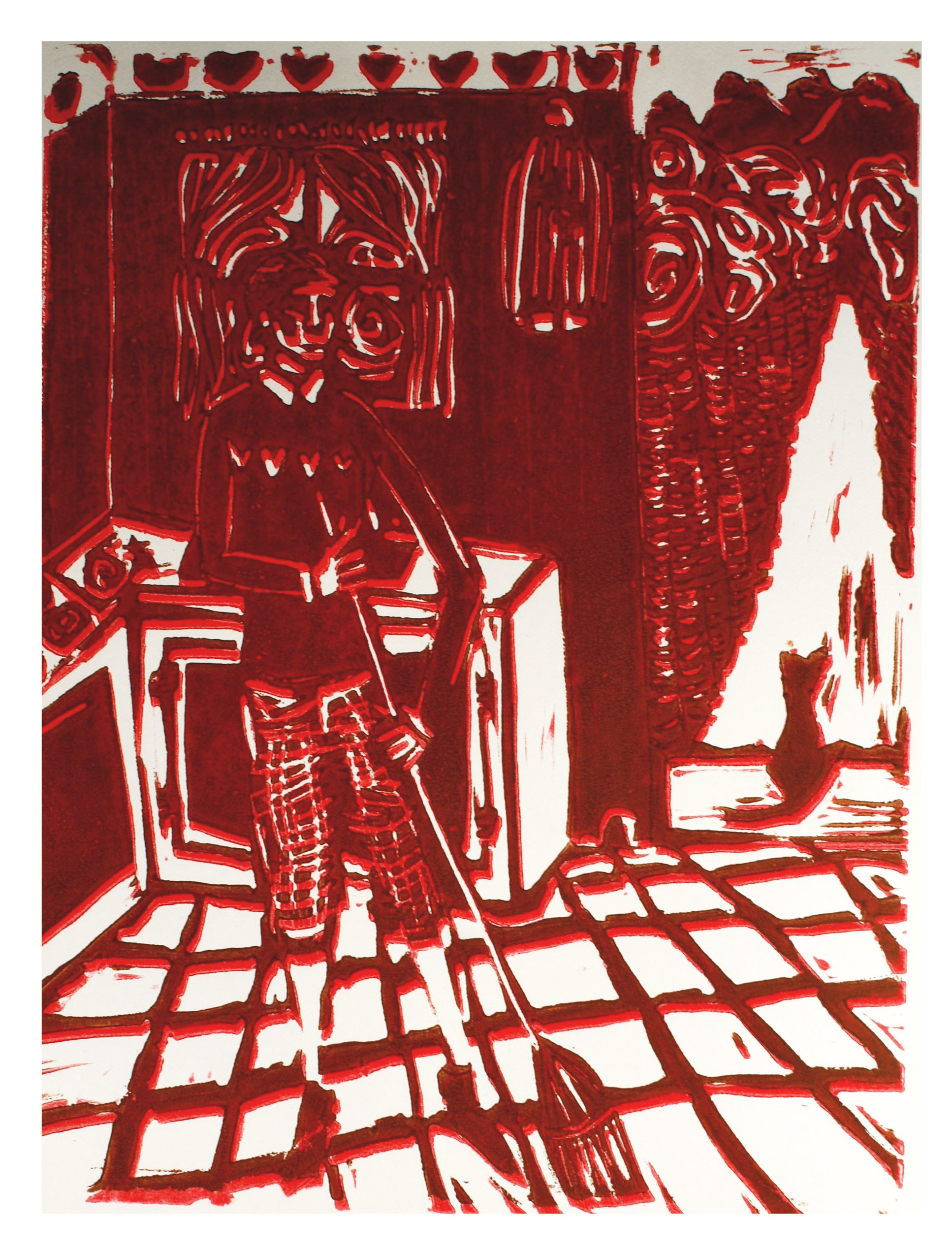
Narrator: Once upon a time there was a boy with a broom. His mother told him “your chore for the day is to sweep your room.” The boy did not grumble. Nor did he stop there. He swept out his room and swept throughout the house. He swept the house and swept right out the door. He swept the whole front porch, and he swept the stone walkway. He just kept sweeping right on into the forest. And, after he swept the whole forest, he moved down into the valley. And, after he was done with that, he moved on towards the desert. He swept and he swept. He swept the mountains, the ocean, as well as the beach. He swept the caves and the underworld. He swept high and low, near and far, deep and wide.
As he finished up a canyon, he stopped at a tall tower. He looked up and saw two damsels in distress. “Hullo” “Hello.” “Nice weather we’re having today, eh?” “Oh yes, quite lovely.” After sweeping around the tower, the boy waved goodbye and continued on sweeping toward the morning light.
Song: The Boy with the Broom
And when I sweep I feel complete.
No matter where I sweep for free.
Cause I sweep all day and sweep all night.
I sweep the dark. I sweep the light.
I sweep a lot.
J. Bradley Minnick: Sweeping and sweeping and sweeping.
Micah: The best traveler has no fixed plans and is not intent on arriving. In order to have an adventure or purpose or meaning, the first boy has to receive something that he himself desires – the red bicycle. This boy just is given a broom, anything at all, whatever life hands the boy, i.e., you the reader, is sufficient to make a life’s work of worth – or work.
Lauren: I just like the image of someone taking something to an extreme level.
Micah: There’s a little bit of insanity to it.
Lauren: And then writing this song was really fun. When we ended up performing this song, Micah got a broom and so I played guitar and sang it while Micah swept.
J. Bradley Minnick: What’s the relationship between work and art in the Sukany household.
Micah: I feel like the relationship could be called culture. In which we have a kind of culture between the two of us and we try to create works of art that would document the culture. So, that was why having a complete work like this was so attractive because it has visual components and auditory components. Like, if you were an anthropologists and you came upon our family, it would be the Sukany tribe. And, they would have their own folktales and their own folk music and their own way of thinking about the world and interpreting what sleep means and what dreams are and all of that stuff.
J. Bradley Minnick: Right, so it’s about sleep and dreams and magic.
Micah: For our little tribe.
J. Bradley Minnick: Tell us a little bit about some of the songs – “The Flight of the Firefly.”
Lauren: Yeah, “The Flight of the Firefly” was a really cool song for us because it involved Micah being on multiple instruments at once.
Micah: Yes, I had a kick drum with my right foot, um I had a guitar in my lap, and a clarinet right next to me. And, each of the sections I’d have to quickly grab it. It was supposed to be kind of like a show piece.
J. Bradley Minnick: That’s great.
Micah: Vaudevillian. Feat of strength.
Lauren: But it would build. It went from kind of being like, “We’re going to go on this adventure to a very full sound towards the end of now “We’re flying and this is the big adventure.
Micah: Yes, it was definitely to see how full we could get with just the two of us.
Lauren: Which has always been a struggle actually.
J. Bradley Minnick: So, let’s hear “The Lantern Dance.”
The Flight of the Firefly
Wish so long for great to happen.
Now it’s here, I’m here with you.
Show me worlds and so much more.
Things are changing, that’s for sure.

Narrator: Long ago there was a beautiful girl, a princess-to-be. She was polite and demure, but enjoyed nothing more than running the hills and forests at night. She kept late hours, dancing wild and barefooted with the woodland creatures. But she grew from a girl into a woman. Soon a prince came out from the palace and took her back as his wife. She exchanged summer dresses for gowns and meadows for ballrooms.
Everyone marveled at her grace and poise, but like a flower pulled by its roots, she began to fade. Seeing this, the prince summoned all of the wisest doctors and apothecaries, but none could find a cure. Hope was gone until one day an old seamstress came to the palace and talked with the prince. “Go away, she is dying and has no more need for gowns now.” So, without a word, the old woman left, but she left behind a gossamer gown. Intrigued, the princess picked up the garment and recognized its patterns at once. She threw the garment on and burst from the palace onto the gardens outside.
As she ran, the summer fireflies rose up around her–flashing and falling, some clinging to her, others rising again. Those in her gown cast out the shadows of the shapes embroidered there. And around her the woodland shadows gathered. She danced and the prince watched in the courtyard.
J. Bradley Minnick: A little different feel. We’ve had bicycles, we’ve had old women, we’ve had brooms sweeping the world, and now we have a kind of traditional fairytale?
Micah: I like the placement because the preceding tale is the boy taking on a nature of the sweeper and then that sort of fills him. So, it’s a self-recognition. In this case, it’s the prince, the outsider, who recognizes “Oh, this is the princess’s real nature. She must be in the wild. She must dance. She must do these wild things.”
J. Bradley Minnick: Do we have a picture that accompanies this? Okay, yes, so this is very abstract.
Lauren: It is the prince watching from the doorway and the princess dancing. And I used two colors, so that it would look like a shadow and then a shadow of the shadow. The woodland creatures would be very abstract. Are they in her dress? Are they on the outside and their shadows are reflected on her dress?
Micah: Yeah, I just thought it would be really pretty to think of a dress that allowed light to pass through with the images of woodland creatures placed into it, so that they cast a shadow out onto the palace walls around her. So, as she dances, the fireflies, which are there because you can’t keep them out are flashing lights. And they’re shining and projecting out the images that she is so familiar with around her. So, she feels that she is in her native environment, even though she really isn’t. She’s still in the palace. And then it was the way of using the image of the firefly again, so stacking that image of the firefly.
J. Bradley Minnick: This is Arts and Letters. You’re listening to “The Boy and the Firefly.” We’re going to talk about the little boy who loved to play the flute, “The Flautist.”

Narrator: Once there was a little boy who loved to play the flute. He practiced whenever he could. He practiced after working in the factory, before bed, and again in the morning before work. He played every day because he loved it. And, when he slept, he dreamed of being a master flautist. However, the boy’s family was poor, so when he woke up, he went to work.
During the same time, there was another boy. He was taught to play the flute; however, he was not an interested student, and paid little attention to his instructor. He would skip out on his lessons to run with older boys and to fish. Despite years of study, the boy had learned only one simple tune.
It was his father’s dream to play the flute, to be a flautist, not his. Every day the father asked his son, “Play for me.” And every day the boy would play the same weak tune. This continued until one day, his father did not ask his son to play. “I’m too weak and too tired to ask you to play for me.” The next day, the father died. The boy missed his father very much.
J. Bradley Minnick: Sad. Kind of sad.
Lauren: A little bit, yeah. Whenever you (Micah) wrote that part, I was like “really, he just dies?”
Micah: I thought it was funny. It’s like the joke at the end. Like, “where are they going? Oh gosh, is this a lesson about art, the nature of art? Is it like that old Japanese story where a student learns the simple tune and it takes him to the very end of his life before he actually plays it with his spirit and then finally he gets approval at the end after mastering the instrument?” No, no. The real thing is that the father dies. That’s it.
J. Bradley Minnick: So, he says, “I’m too weak and too tired to ask you to play for me,” but that doesn’t mean he doesn’t want him to play.
Micah: That’s true. He still has those desires.
J. Bradley Minnick: And then he dies.
Micah: And then he dies. That’s it.
J. Bradley Minnick: Could we talk a little bit about the flute itself and what kind of images it conjures up in this story.
Micah: Well, literally, the Japanese story was what I had in mind when I was writing this. So, I was hoping the flute would tip the reader off to think about that story. About how it takes a lifetime of suffering and joy to move beyond simple technical mastery to artistic mastery. And, so I was hoping that the reader would think, “Oh, flute, okay, there’s that tale. There’s a very similar structure. The boy is playing. It’s discipline and all of that stuff. Master.” And then be surprised that the real heart of the story is about a father and son being distracted by some sort of pursuit, when their relationship and the death of the father is really the crux. That’s everything. Or, I mean, in also kind of like a dream, in which it seems to be going in one direction and then an event happens and then that’s the thing. It’s kind of like nonsense or not meaning. There’s no meaning here. Boom.
J. Bradley Minnick: Um, I do like though the meaning is a little bit about mastery. Because despite years of study, the boy had only learned one simple tune.
Micah: I also wanted you to be able to read in to the simple tune that the father and sons relationship is one note at this point.
J. Bradley Minnick: So, just tell us about wrapping this up. You have, and they’re not disparate tales, but they’re loosely connected “Jungian” moments. How do we wrap something like this up?
Lauren: That’s what I kept saying. “Micah, is Calipso going to be changed? Will he go back and his brothers and sisters respect him? Like, how should we finish this thing?”
Micah: I was really hoping that the final conversation between Calipso and the firefly would clue people in to what they should take from it. The final story gives you an indication of what it’s all about. Yes, it could have been really good for the son to have mastered the flute. It would have helped the father and son relationship, but that’s really not what it’s about. In the sense that, it doesn’t really matter once he’s dead. It all disappears. It’s important, but it’s not important. A dream feels so vivid and real because you both believe that it’s real, but know that it’s not. If you approach life with the same perception “this is important and it’s not,” you’re going to do well. It will have all the vividness and excitement of a dream being both attached to it and also with bearing in mind that none of it really matters.
J. Bradley Minnick: We imagine we have a dream and that we can attain that dream, but in some ways you’re saying I think that we have the dream life and we have real life, and sometimes they cross over. And, sometimes they don’t.
Micah: I think we try to resolve that in the stories by saying that, that your nature is what matters. So, there’s your dreams and there are dreams that are against your nature and there are dreams that are with your nature. The characters that do well are the characters that dream along the lines of their own natures.
Narrator: Stepping back onto the bridge, Calipso felt that he was somehow different. He felt bolder and more alive. “I love to dream. I can be or do anything.” “So many people feel that way, but a dream is something that just happens to you. Like life, it is little more than that.” “Then why do I feel so free here?” “Because you believe so well, and yet you do not believe at all. It is a paradox, but you will understand more as you grow.” Calipso and the firefly left the way they came. They passed through the clouds and fields of white–flying over the clouds beneath the moon.
Twinkle Twinkle
Twinkle, twinkle little star.
How I wonder what you are.
Up above the world so high.
Like a diamond in the sky.
Twinkle twinkle little star.
How I wonder what you are.
Starlight, star bright, the first star I see tonight.
I wish I may, I wish I might.
Have this wish I wish tonight.
Narrator: Calipso saw the towns and villages twinkling like fireflies. He began to understand. Looking ahead Calipso saw a bright star hovering in the eastern sky. It was the last star before morning. Without hesitation, Calipso closed his eyes and made a wish.
J. Bradley Minnick: Broadcast from the studios of KUAR in Little Rock, you’ve been listening to Arts and Letters. Thanks for joining us. If you’d like to listen to this broadcast with accompanying “The Boy and the Firefly” illustrations, go to kuar.org. Leave us a comment there, and let us know what you thought about the program. Thank you to writers, illustrators, musicians, and songwriters Lauren and Micah Sukany. Whose fractured fairytale, “The Boy and the Firefly” collects our dreams, reconstitutes our true natures, and reconsiders the dream traveler in all of us. Thanks to the sound engineering of Mr. Chris Hickey, who helps us produce these shows. Generous funding for this episode provided by the Arkansas Humanities Council and the National Endowment for the Humanities. For Arts and Letters, I’m J. Bradley Minnick. Let’s heed the words of Carl Jung, “Dreams are the guiding words of the soul. Why should I henceforth not love my dreams and not make their riddling images into objects of my daily consideration.”

You can read The Boy and the Firefly online at paperopera.com/2017/08/13/the-boy-and-the-firefly/
You can listen online at KUAR Arts and Letters The Boy and the Firefly at ualrpublicradio.org/post/fractured-fairytale
You can listen to The Boy and the Firefly Story and Songs at thedamselsindistress.bandcamp.com/album/the-boy-and-the-firefly